Eugene Quinn for East Greenwich Schools
Why I believe the masking option should be kept open
I don't believe we can rule out another wave of SARS2-CoV-19A due to a new variant.
Should that occur, I believe the importance of keeping schools open safely dictates that we consider all mitigations that have been shown to be effective. While common sense suggests that masking should reduce the spread of a pathogen whose transmission is primarily by airborne droplets, it's a difficult study to perform because there are so many factors. That said, solid evidence that masks can slow the spread of COVID is emerging.2 When I found a paper that applied the Susceptible-Infected-Removed (SIR) model to the SARS2-CoV-19 pandemic1 and a second paper that quantified the relative odd ratios for masking, I thought of combining the results in a model for a hypothetical future COVID wave by:- Setting the parameters of the SIR model to mimic the Omicron wave
- Using the adjusted odds ratios from the masking study to reduce the infection rate coefficient
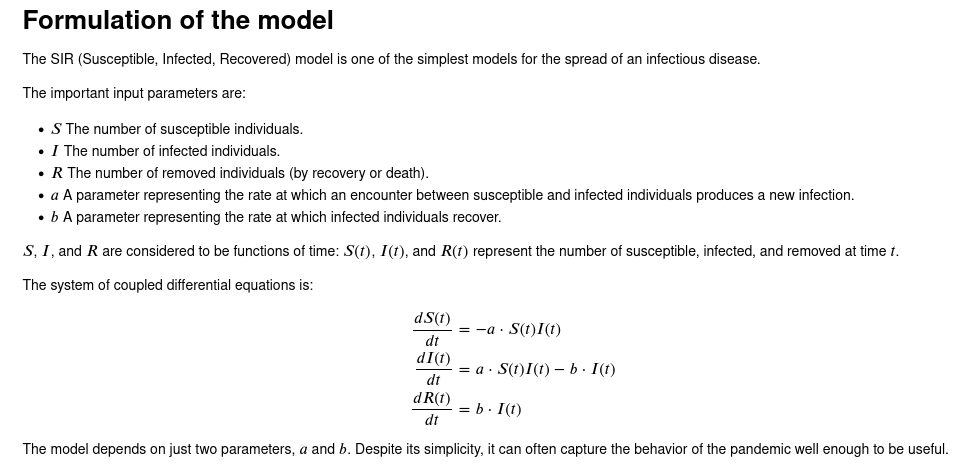
The Susceptible-Infected-Removed (SIR) model is one of the simplest models for an epidemic.
Despite its simplicity, the SIR model has been used to model the spread of SARS-CoV-2.1
The model partitions the population into three compartments or states, and uses a coupled system of Ordinary Differential Equations to model transitions between compartments. Despite its simplicity, the SIR model can produce complicated dynamics.
Characteristics
- The rate of new infections is proportional to the product of the number of susceptibles times the number of infecteds
- Usually at the beginning the population is almost entirely susceptible, with a handful of infected
- As the number of infected increases, the product increases rapidly and so does the rate of new infections.
- The parameter a determines the rate of new infections for each unit of infected times susceptible.
- The parameter b determines the rate of removal (by recovery or death) for each infected individual.
- As the number of infected increases, the number of susceptibles decreases
- When a times the product of infected and susceptibles equals b times the number of infected, the number of infected peaks
- After that, the number of infected undergoes exponential decay
- The width and height of the peak is completely determined by the parameters a and b
- Usually at the beginning the population is almost entirely susceptible, with a handful of infected
- As the number of infected increases, the product increases rapidly and so does the rate of new infections.
- The parameter a determines the rate of new infections for each unit of infected times susceptible.
- The parameter b determines the rate of removal (by recovery or death) for each infected individual.
- As the number of infected increases, the number of susceptibles decreases
- When a times the product of infected and susceptibles equals b times the number of infected, the number of infected peaks
- After that, the number of infected undergoes exponential decay
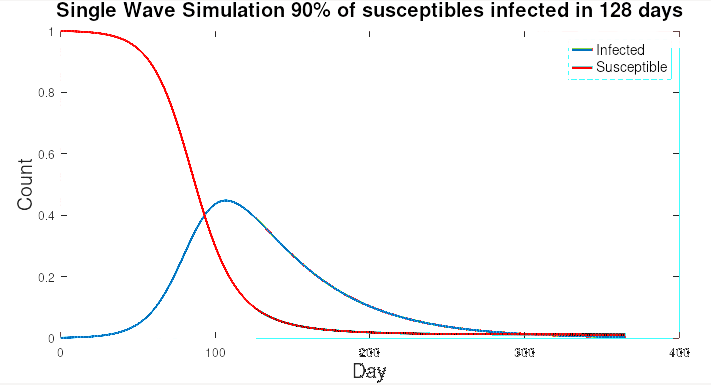
This is the baseline model.
It's patterned after the Omicron wave, with a single peak and 90% of the susceptibles infected in 128 days. The peak number of infected is about 45% of the original susceptibles. Eventually virtually all of the susceptibles become infected.Masking with unspecified mask type
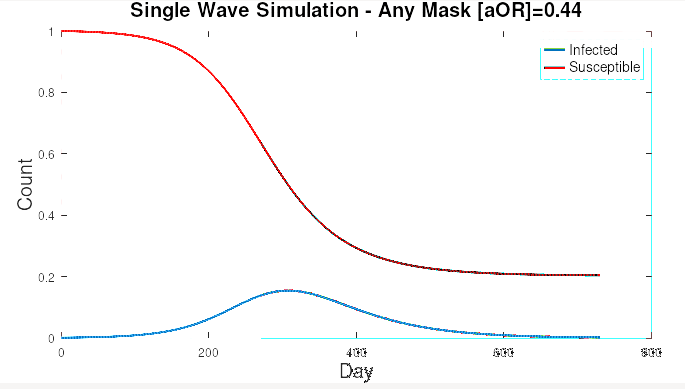
The adjusted odds ratio (relative to baseline) is 0.441
The peak number of infections is just under 20% of the susceptibles. Eventually about 80% of the susceptibles become infected, but it takes nearly two years.Masking with surgical masks
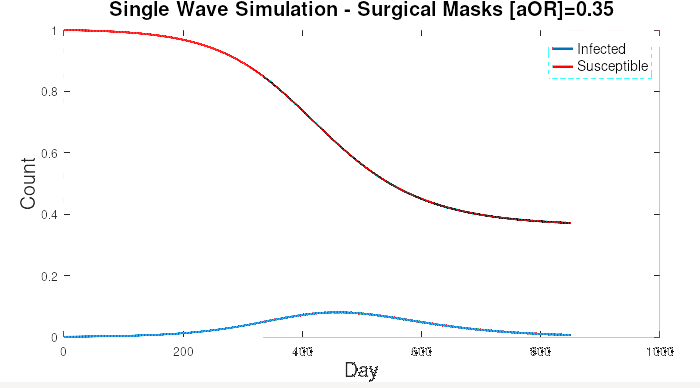
The adjusted odds ratio (relative to baseline) is 0.351
The peak number of infections is about 10% of the susceptibles. Eventually about 60% of the susceptibles become infected, but it takes nearly two years.Masking with N95 masks
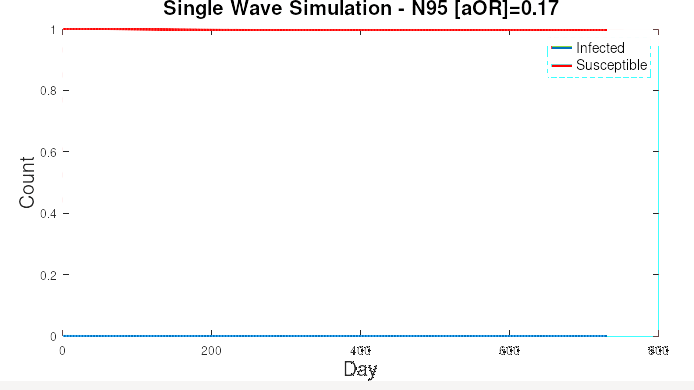
The adjusted odds ratio (relative to baseline) is 0.171 with N95 masks, the original infecteds recover quickly, without infecting many susceptibles.
1The SIR model was used in a manner similar to the following article from Pub Med Central: A SIR model assumption for the spread of COVID-19 in different communities
2Odds ratios for various masking options are take from this California case-control study of mask effectiveness:
Effectiveness of Face Mask or Respirator Use in Indoor Public Settings for
Prevention of SARS-CoV-2 Infection — California, February–December 2021