Long Term Financial Sustainability of East Greenwich Public Schools
The Sustainability Question
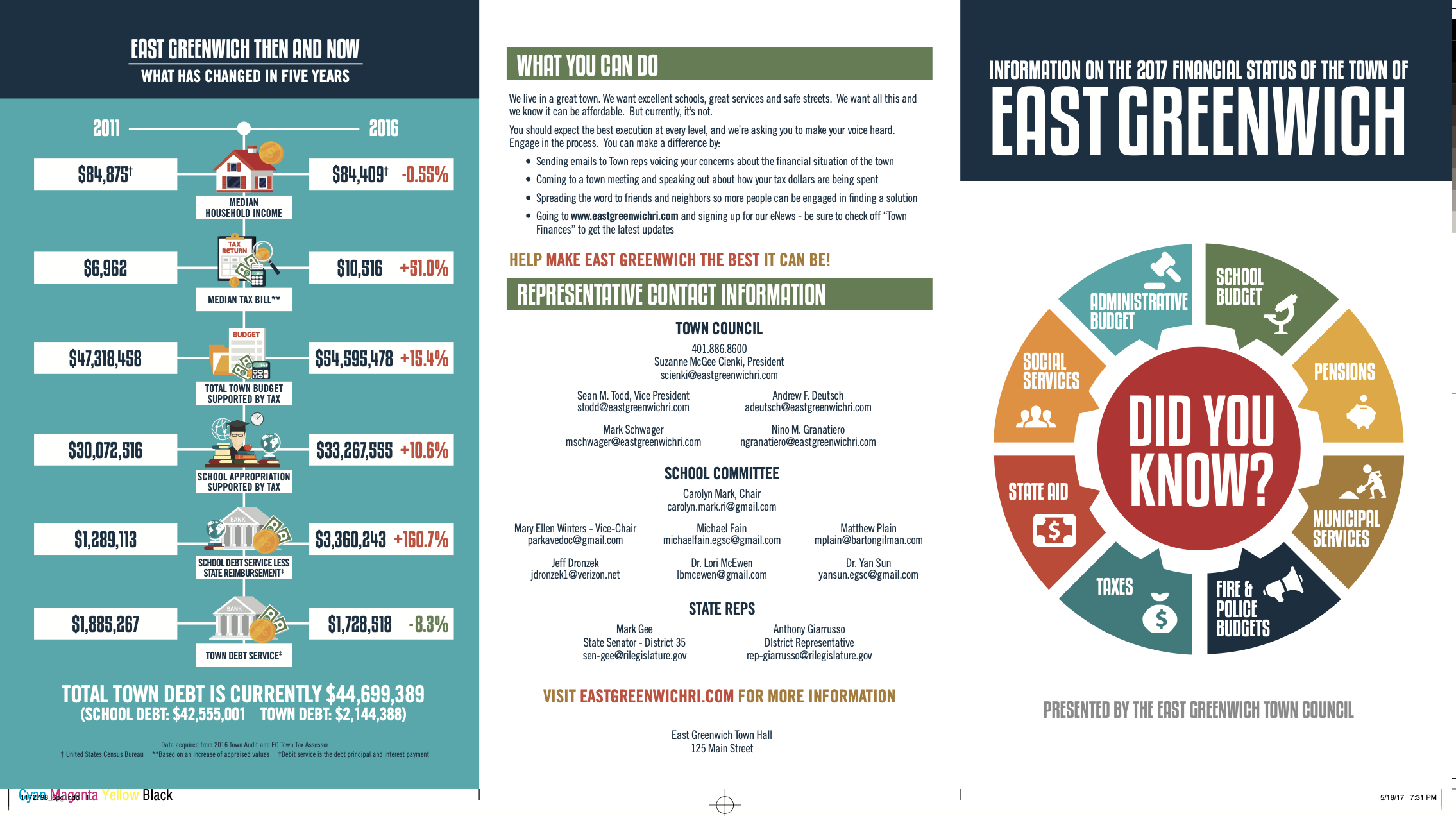
May 2017 Resident Mailer, designed to pave the way for level-funding the schools.
In 2017 the town council sent a mailer to all residents claiming that town finances were on an unsustainable path.
This was based on completely wrong information about the rate of increase of tax bills.
The mailer claims that the median tax bill for single-family homes rose 51% between 2011 and 2016.
The correct number was 13%, just over one quarter of what was claimed.
Nevertheless, based on the 51% number, the council level-funded the schools and cut the town budget.
The resulting cuts to the school department threatened the accreditation of EGHS.
Total Property Tax from All Classes
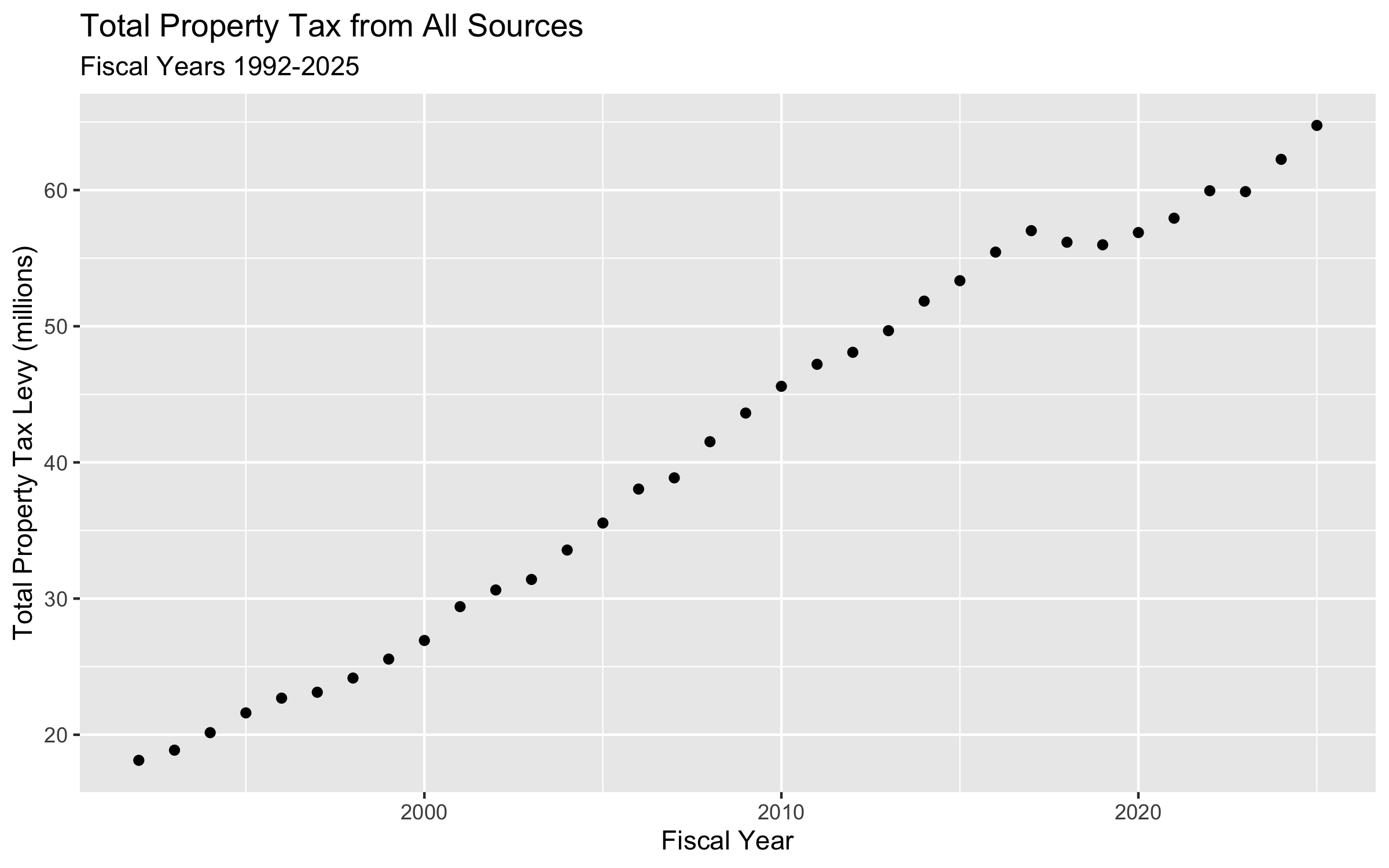
Total Property Tax Revenue from All Classes for Fiscal Years 1992-2025
East Greenwich has long enjoyed a reputation for sound fiscal management.
Over the years our town managers and finance directors have been remarkably successful in smoothing the tax impact of various events that might have been expected to have a large impact on the levy.
2000 Peak of the Dot Com Bubble
2002 Dot Com Bubble bursts
2003 Real Estate Bubble begins
2006 Real Estate Bubble peaks
2008 The Great Recession begins
2010 Cole Middle School construction
2011 4% property tax cap fully phased in
2014 Incorporation of the fire district
In 2017 and 2018, overly aggressive budget cutting has a larger effect on the tax levy than any of the events listed above.
We are pretty much back on the historical near-linear growth pattern, with the tax levy expected to grow by about $1.8 million in a typical year.
The historical evidence suggests that this trajectory is stable, fairly predictable, and sustainable, and if you see a drastic change, it's probably a mistake.
Looking Forward
This community has invested decades of effort and hundreds of millions of dollars in its school system. It should be viewed as a valuable asset that is worth preserving.
This year state officials are warning that the generous increases in state education aid we have seen in recent years are unlikely to continue.
It is good to consider this against the historical record, which shows we have weathered many challenges in the past and found ways to stabilize our finances in spite of them.